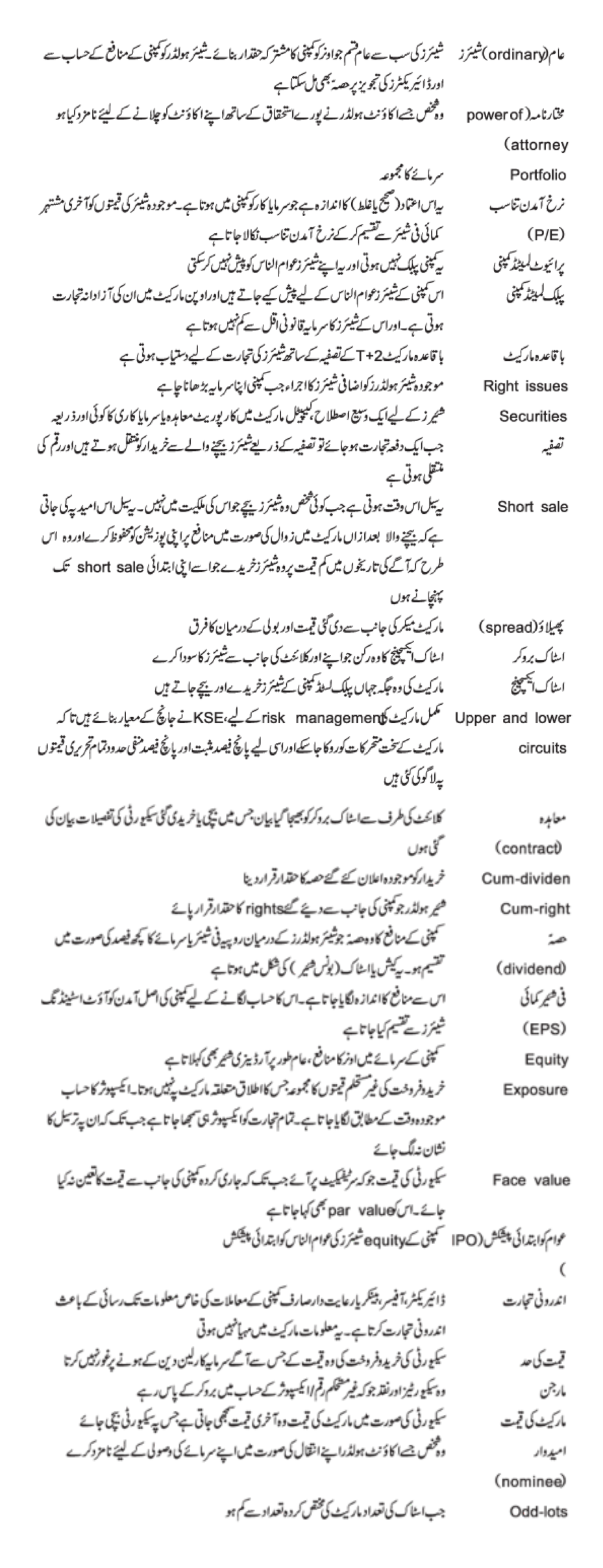
| Terms |
Explanation |
| Annual Report |
Formal financial statements, the Auditors’ Report, together with the Directors’ Report issued by a company. These financial statements are usually prepared at the close of the company’s financial year. |
| Arbitrage |
The simultaneous purchase and sale of the same security on different stock exchanges at prices which yield a profit. |
| Bear |
An investor who anticipates for a decline in stock prices. |
| Bear Market |
A market in which stock prices are declining in general. A serious decline is called a depression. A short decline in a generally rising market is looked upon as a technical correction. |
| Bid and Ask |
The bid is the highest price any one has offered to pay for a security at a given time; the asked is the lowest price any one has offered to accept for a security at a given time. |
| Blue Chip |
A large well-established company with a history of profitable operation. |
| Book Closing |
The closure of books by a company to determine the shareholders’ rights to receive bonus, dividend, rights, etc. No transfers are recorded during this period. |
| Boom |
Denotes greater activity on the stock exchange |
| Bull |
An investor who anticipates for a rise in stock prices. |
| Bull Market |
A market in which stock prices are rising in general. If the market is recovering from a deep decline, the early stage of the uptrend is called an up reversal, turnaround, rally or recovery. |
| Capital Gain/ Loss |
Profit or loss arising from the sale of securities. |
| Capital Gain tax |
Tax payable on profit arising from appreciation in value of investment, realized at the time of selling or maturity of investment. |
| Clearing |
Settlement or clearance of dues accounts in stock exchanges. |
| Collateral |
Securities or other properties pledged by a borrower to secure the repayment of a loan. |
| Commission |
The fees payable by a client to the stock broker for trading in securities on his behalf. |
| Contract |
A statement sent to a client by the stockbroker, giving details of securities purchased or sold. |
| Cum-dividend |
The term implies that the buyer is entitled to the dividend currently declared. |
| Cum-right |
Shares having the right to receive the upcoming rights issues offered by the company. |
| Dividend |
That part of a company’s profits which is distributed among shareholders, usually expressed in rupee per share or percentage to paid up capital. It could be in the form of cash or stock (Bonus Share). |
| Earnings per Share (EPS) |
A profitability indicator calculated by dividing the net after tax earnings available to common stockholders during a period by the average number of shares outstanding at the end of that period. |
| Equity |
The owners’ interest in a company’s capital usually referred to as ordinary shares. |
| Exposure |
Aggregation of unsettled amount of purchases and sales under each Market with no netting applicable to respective Market. The exposure is calculated using real-time values. All trades are counted as exposure unless they are marked for delivery. |
| Face Value |
The value of a security that appears on the face of the certificate unless the value is otherwise specified by the issuing company. It is also termed as par value. |
| Initial Public Offering (IPO) |
The offering of equity shares of a company to the general public for the first time. |
| Insider Trading |
Insider trading normally occurs when an insider, that is, a director, an officer, a banker or a favored customer, due to his access to special information about the company’s affairs, which has not been made available to the market influence the value of shares to his advantage. |
| Limit Price |
The price beyond which an investor would not consider executing a transaction involving the purchase or sale of securities. |
| Margin |
Securities and cash held with broker against any outstanding unsettled amount/exposure |
| Market Price |
In case of a security, market price is usually considered the last reported price at which the security is sold. |
| Nominee |
An individual who is designated by the account-holder to receive all cash and custody in case of the account holder’s demise. |
| Odd-Lots |
A quantity of stock less than the established/ allowed unit of trading in regular market. |
| Ordinary Shares |
The most common form of shares, which entitle the owners to jointly own the company. Holders may receive dividends depending on profitability of the company and recommendation of directors. |
| Power of Attorney |
An individual who is designated by the account-holder to operate the account with the same privileges as the account holder. |
| Portfolio |
A collection of investments. |
| Price/Earnings Ratio (P/E) |
The P/E ratio is a measure of the level of confidence (rightly or wrongly) investors have in a company. It is calculated by dividing the current share price by the last published earnings per share. |
| Private Limited Company |
A company that is not a public company and which is not allowed to offer its shares to the general public. |
| Public Limited Company |
A company whose shares are offered to the general public and traded freely on the open market and whose share capital is not less than a statutory minimum. |
| Regular Market. |
Regular market available for shares trading with regular settlement of T+2. |
| Right Issue |
The issue of additional shares to existing shareholders when companies want to raise more capital. |
| Securities |
A broad term for shares, corporate bonds or any other instrument of investment in the capital market. |
| Settlement |
Once a trade has been executed, the settlement process transfers shares from seller to buyer and arrange the corresponding exchange of money between buyer and seller. |
| Short Sale |
It occurs when a person sells shares that he does not own. A short sale is usually made in the hope that a subsequent market decline will enable the seller to ‘cover his position’ at a profit, that is, to buy at a later date and at a lower price the shares he needs to deliver against his original short sale. |
| Spread |
The difference between the bid and offer price of a market maker. |
| Stock Broker |
A member of the stock exchange who deals in shares for his own and behalf of clients. |
| Stock Exchange |
The market place where shares of public listed companies are bought and sold. |
| Upper & Lower Circuits |
For overall market risk management, the KSE has built in checks to curb drastic market movement, and has placed a 5% positive and negative limit on all scrip prices. |